110+ How Did Samuel Die in the Bible? The Prophet’s Final Years, Age, and Legacy
Samuel’s life in the Bible begins with a dramatic prayer and ends with a single quiet sentence. His mother Hannah wept so hard at the tabernacle that a priest thought she was drunk. Decades later, after Samuel had judged Israel, anointed its first two kings, and confronted a disobedient ruler face to face, the Bible records his passing in just a few words.
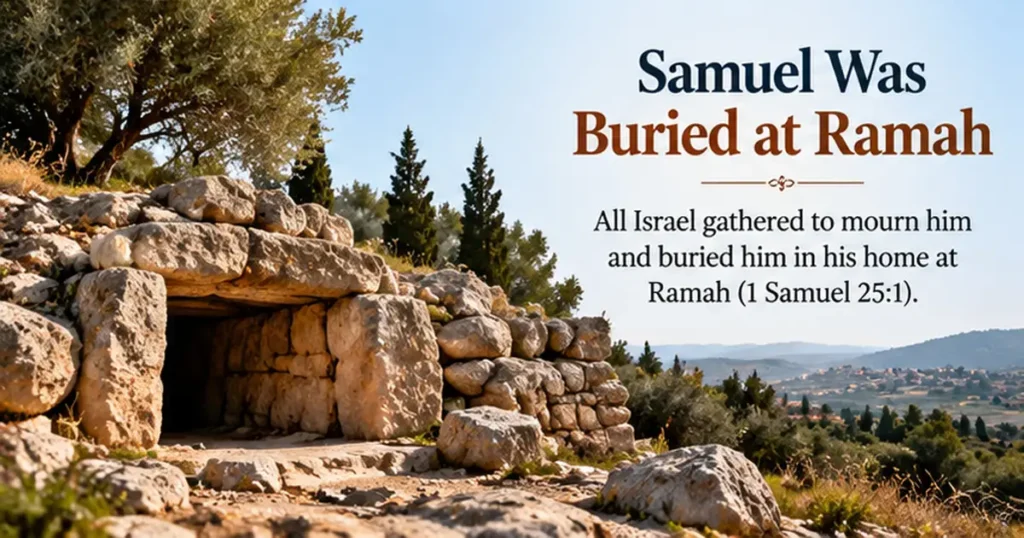
So how did Samuel die in the Bible? The short answer is that he died a natural death in old age. Scripture gives no sign of illness, violence, or accident. First Samuel 25:1 simply states that Samuel died, that all Israel gathered to mourn him, and that he was buried at his home in Ramah.
That brief report raises natural follow-up questions. How old was Samuel when he died? Why does the Bible mention his death twice? What happened when King Saul tried to contact him after he was gone? And why do Jewish and Christian traditions remember him so highly?
This article answers each of those questions using the biblical text first, then the classic Jewish and Christian commentaries that have tried to fill in the gaps. Where the Bible is silent, you will see clearly that the information comes from later tradition rather than Scripture itself.
The Short Answer: Samuel Died of Old Age
The Bible’s account of Samuel’s death is remarkably brief.
“And Samuel died; and all the Israelites were gathered together, and lamented him, and buried him in his house at Ramah. And David arose, and went down to the wilderness of Paran.” (1 Samuel 25:1, KJV)
Notice what the verse does not say. It names no disease, no battle wound, no murder, and no miracle. In Hebrew narrative, that kind of plain report usually signals an ordinary, natural death. Samuel had already described himself as “old and grayheaded” years earlier (1 Samuel 12:2), so the most reasonable reading is that he died peacefully after a long life.
Why Samuel’s Death Matters in the Story
The placement of the verse is significant. It appears right as David is on the run from Saul. Samuel had anointed David as Israel’s next king (1 Samuel 16:13), and he had sheltered David at Naioth in Ramah when Saul first tried to kill him (1 Samuel 19:18). With Samuel gone, David loses his most respected ally and protector. Saul, meanwhile, loses the one spiritual voice that still spoke honestly to him.
What Happened to Samuel in the Bible? His Life Before His Death
Understanding Samuel’s death is easier when you see the full arc of his life. His story spans the end of one era and the beginning of another.
A Child of Prayer
Samuel’s mother, Hannah, was unable to have children and was taunted by her husband’s other wife. She poured out her heart at the tabernacle in Shiloh and promised that if God gave her a son, she would dedicate him to the Lord for life (1 Samuel 1:10–11). When Samuel was born, she named him with a word that sounds like the Hebrew for “asked of God.” After he was weaned, she brought him to serve under Eli the priest.
The Voice in the Night
As a boy, Samuel heard God call his name in the night. Thinking it was Eli, he ran to the old priest three times before Eli realized the Lord was speaking. Samuel’s response, “Speak; for thy servant heareth” (1 Samuel 3:10, KJV), became a model of humble listening. The first message he received was a sobering judgment on Eli’s corrupt sons.
Prophet to the Nation
Scripture says that “all Israel from Dan even to Beersheba knew that Samuel was established to be a prophet of the LORD” (1 Samuel 3:20, KJV). God let none of his words “fall to the ground,” meaning his prophecies proved true.
Judge and Deliverer
After the Philistines captured the ark and Eli died, Samuel called Israel to abandon foreign gods. At Mizpah, he prayed and offered a sacrifice while the Philistines attacked, and God threw the enemy into confusion (1 Samuel 7:10). Samuel set up a stone there and named it Ebenezer, saying, “Hitherto hath the LORD helped us” (1 Samuel 7:12, KJV).
Kingmaker
When Israel demanded a king, Samuel felt rejected, but God told him the people had rejected God, not Samuel (1 Samuel 8:7). Samuel warned them about the costs of monarchy, then anointed Saul. Later, after Saul’s repeated disobedience, Samuel delivered God’s verdict that the kingdom would be taken from him and quietly anointed the shepherd boy David in Bethlehem.
Samuel’s Final Years: Disappointment and Faithfulness
Samuel’s last chapter was not easy, and that makes his peaceful death all the more striking.
Sons Who Did Not Follow His Example
In his old age, Samuel made his sons Joel and Abiah judges in Beersheba, but they took bribes and perverted justice (1 Samuel 8:1–3). Their failure gave the elders their reason to ask for a king. Samuel, who had served with such integrity, had to watch his own family fall short.
Grieving Over Saul
After announcing Saul’s rejection, Samuel never visited him again, yet the Bible says he “mourned for Saul” (1 Samuel 15:35, KJV). God eventually asked him how long he would keep grieving and sent him to anoint David (1 Samuel 16:1).
A Refuge for David
When Saul began trying to kill David, the young man fled to Samuel at Ramah. Saul sent messengers to capture him there, but each group was overcome by the Spirit and began to prophesy. Eventually Saul came himself and experienced the same thing (1 Samuel 19:18–24). It is the last time Samuel appears alive in the narrative, surrounded by a company of prophets in his hometown.
A Farewell Without Regret
Samuel’s farewell speech in 1 Samuel 12 shows a leader with a clear conscience. He asked the people to testify if he had ever taken anyone’s ox or donkey, cheated anyone, or accepted a bribe. They answered that he had not. He promised to keep praying for them, saying that to stop would be a sin against the Lord (1 Samuel 12:23). Few leaders in Scripture end their public service with such an unblemished record.
The Two Places the Bible Mentions Samuel’s Death
Samuel’s death is recorded twice in 1 Samuel, and each mention serves a different purpose.
First Samuel 25:1 — The Death Notice
The first mention announces the death itself and the national mourning. It functions like an obituary placed in the middle of David’s story.
First Samuel 28:3 — The Reminder Before Endor
The second mention repeats the facts just before one of the strangest scenes in the Old Testament.
“Now Samuel was dead, and all Israel had lamented him, and buried him in Ramah, even in his own city.” (1 Samuel 28:3, KJV)
The narrator reminds readers that Samuel is gone so that what happens next, Saul’s visit to a medium at Endor, carries its full weight.
How Old Was Samuel When He Died?
The Bible never states Samuel’s age at death. That silence has led to several different estimates over the centuries.
What the Bible Hints
A few biblical details help narrow the range:
- Samuel was a young boy when he began serving under Eli the priest (1 Samuel 2:11, 18).
- He “judged Israel all the days of his life” (1 Samuel 7:15).
- When Israel asked for a king, the elders told Samuel he was old (1 Samuel 8:5).
- At Saul’s coronation, Samuel called himself “old and grayheaded” (1 Samuel 12:2).
- He lived long enough afterward to reject Saul, anoint David, and shelter David from Saul.
Put together, these clues suggest Samuel lived into old age by the standards of his time.
The Jewish Tradition: About 52 Years
The Babylonian Talmud records a surprising tradition that Samuel lived only 52 years. One passage (Moed Katan 28a) even uses dying in one’s fifty-second year as a kind of shorthand for “the death of Samuel the Ramathite.” Another passage (Taanit 5b) explains the tension with 1 Samuel 8:1, which calls Samuel old, by saying that old age came upon him prematurely because of his grief over Saul and the burden of leadership.
This is a rabbinic tradition, not a statement found in the Hebrew Bible itself.
Christian Commentators: Older Estimates
Many Christian scholars have favored a much older age. Easton’s Bible Dictionary suggests Samuel probably died at about eighty. The Orthodox Church’s traditional life of Samuel describes him as dying in extreme old age. Older Catholic commentaries record a wide spread of estimates, some placing him in his seventies and others near one hundred.
A Comparison of the Estimates
| Source | Estimated age at death | Basis |
| Hebrew Bible | Not stated | Calls him old and gray-haired (1 Samuel 12:2) |
| Babylonian Talmud | About 52 | Rabbinic tradition of premature aging |
| Easton’s Bible Dictionary | About 80 | Reconstruction from the biblical timeline |
| Orthodox tradition | Extreme old age | Church tradition about the prophet’s life |
| Older Catholic commentators | Roughly 77 to 98 | Varying chronological calculations |
The honest conclusion: we do not know Samuel’s exact age, but the biblical text clearly presents him as an elderly man at the end of his life.
When Did Samuel Die? Timing Relative to Saul and David
Samuel’s death happened during the years when Saul was hunting David, after Saul had already been rejected as king but before Saul’s final battle on Mount Gilboa.
How Long Before Saul’s Death?
The Bible does not specify the gap. Jewish chronologies offer different answers. Some say Samuel died only months before Saul, while others suggest a year or two. The eighteenth-century commentator John Gill pointed to 1 Samuel 27:7, which says David lived among the Philistines for a year and four months, and argued that Samuel must have died at least that long before Saul.
Where This Fits in Samuel’s Life
| Event | Reference |
| Hannah prays for a son and dedicates Samuel to God | 1 Samuel 1 |
| Samuel serves Eli at Shiloh and hears God’s call | 1 Samuel 3 |
| Samuel leads Israel to victory at Mizpah | 1 Samuel 7 |
| Israel demands a king | 1 Samuel 8 |
| Samuel anoints Saul | 1 Samuel 10 |
| Samuel’s farewell address to the nation | 1 Samuel 12 |
| Samuel confronts Saul and announces his rejection | 1 Samuel 15 |
| Samuel secretly anoints David | 1 Samuel 16 |
| David flees to Samuel at Ramah | 1 Samuel 19 |
| Samuel dies and is buried at Ramah | 1 Samuel 25:1 |
| Saul consults a medium about Samuel | 1 Samuel 28 |
Where Was Samuel Buried?
The Bible says Samuel was buried “in his house at Ramah” (1 Samuel 25:1, KJV) and “in Ramah, even in his own city” (1 Samuel 28:3, KJV).
What “In His House” Means
Most commentators do not think Samuel was buried inside the building where he lived. Israelite purity laws treated contact with graves as making a person ritually unclean (Numbers 19:16), which would have made burial inside a home impractical. The phrase more likely means he was buried on his family property or in a family tomb at Ramah, close to where he had lived and worked. Some Jewish writers suggested his parents, Elkanah and Hannah, were buried there too.
Ramah: Samuel’s Hometown
Ramah, also called Ramathaim-zophim (1 Samuel 1:1), was Samuel’s birthplace, his home base as a judge, and the place where he gathered a company of prophets. He traveled a yearly circuit to Bethel, Gilgal, and Mizpah, but he always returned to Ramah (1 Samuel 7:16–17). It is fitting that he was laid to rest there.
Later Traditions About Samuel’s Tomb
A hilltop site northwest of Jerusalem, known in Arabic as Nabi Samwil, “the Prophet Samuel,” has been honored as Samuel’s tomb since at least the Byzantine era and is still visited by Jewish, Christian, and Muslim pilgrims. Ancient sources also report that relics associated with Samuel were moved to the region of Constantinople under the Roman emperor Arcadius in the early fifth century. Historians debate whether Nabi Samwil is the biblical Ramah, and many scholars identify Ramah with a different nearby location.
How All Israel Mourned Samuel
The Bible says “all the Israelites were gathered together, and lamented him.” That kind of national mourning was rare and usually reserved for leaders of extraordinary stature, such as Moses (Deuteronomy 34:8) and Aaron (Numbers 20:29).
Why the Nation Grieved
Samuel had served Israel from childhood to old age. He led spiritual renewal, delivered the nation from the Philistines, judged disputes fairly, and stood as a living link between the era of the judges and the age of the kings. When he challenged the people at Saul’s coronation to name anyone he had cheated or oppressed, no one could (1 Samuel 12:3–5). His death left a hole no one else could fill.
What Happened to Samuel After His Death? The Medium at Endor
The most discussed part of Samuel’s story actually happens after he died.
Saul’s Desperate Visit
Facing a massive Philistine army and receiving no answer from God through dreams, the Urim, or prophets, Saul disguised himself and visited a woman at Endor who was known as a medium (1 Samuel 28:5–8). This was a deeply ironic move, since Saul himself had earlier expelled mediums from the land (1 Samuel 28:3, 9).
Samuel Appears
When the woman called up Samuel, she cried out in apparent shock and described an old man coming up, covered with a robe. Saul recognized it as Samuel (1 Samuel 28:12–14). The figure spoke:
“And Samuel said to Saul, Why hast thou disquieted me, to bring me up?” (1 Samuel 28:15, KJV)
Samuel then repeated his earlier verdict: God had torn the kingdom from Saul and given it to David. He added a chilling prophecy that Saul and his sons would be with him the next day (1 Samuel 28:19). Saul died in battle on Mount Gilboa shortly afterward (1 Samuel 31).
How Interpreters Understand the Endor Story
Readers have debated this passage for centuries. The main views include:
- A real appearance permitted by God: Many interpreters, noting the medium’s surprise and the accuracy of the prophecy, believe God allowed Samuel to appear as a final word of judgment.
- A demonic impersonation: Some early Christian writers argued that an evil spirit imitated Samuel, since God would not work through a forbidden practice.
- A deception by the medium: A few interpreters suggest the woman staged the event, though the details of the text make this harder to sustain.
The book of Sirach, included in Catholic and Orthodox Bibles, appears to take the appearance at face value, saying that even after Samuel fell asleep he prophesied to the king (Sirach 46:20). First Chronicles 10:13 adds that Saul died partly because he consulted a medium instead of seeking the Lord.
What Samuel’s Death Teaches Us
Samuel’s quiet death invites reflection, especially when set beside the noise of Saul’s final days.
Faithfulness to the End
Samuel did not retire from faithfulness when he stepped back from leadership. Even after Saul’s rejection, Samuel kept praying and grieving for him (1 Samuel 15:35; 12:23). He finished his life with integrity intact.
Influence Outlasts a Lifetime
David’s kingship, the prophetic schools, and Israel’s memory of Samuel all continued after his death. His work shaped the nation long after he was buried.
Grief and Hope
The Bible does not hide Israel’s sorrow. Mourning is a proper response to loss. Yet Scripture also lists Samuel among the heroes of faith in Hebrews 11:32, people who “died in faith” looking toward God’s promises.
Samuel’s Legacy in the Rest of Scripture
Samuel’s name appears far beyond the books that bear his name.
- Jeremiah 15:1 pairs him with Moses as one of Israel’s greatest intercessors.
- Psalm 99:6 names him among those who called on the Lord and were answered.
- Acts 3:24 presents Samuel as the first in a line of prophets who foretold the days of Jesus.
- Acts 13:20 refers to the era of judges “until Samuel the prophet.”
- Hebrews 11:32 includes him in the honor roll of faith.
Christian tradition often describes Samuel as the last of the judges and the first of the great prophets, a bridge between two eras in Israel’s history.
How Different Faith Traditions Remember Samuel
Samuel’s memory extends well beyond the Bible’s pages.
In Judaism
Jewish tradition honors Samuel as one of the greatest prophets and credits him, according to the Talmud, with writing the book that bears his name along with Judges and Ruth. Some Jewish communities have observed his traditional date of death, the 28th of the month of Iyar, with prayer and visits to Nabi Samwil.
In Christianity
Christians remember Samuel as a model of attentive listening, faithful intercession, and courageous honesty with those in power. The Eastern Orthodox and Catholic churches commemorate him on August 20.
In Islam
The Qur’an refers to an unnamed prophet whom the Israelites asked to appoint a king (Qur’an 2:246–248). Muslim commentators commonly identify this prophet with Samuel, known in Arabic as Shamwil, which is one reason the Nabi Samwil site is honored by Muslims as well.
Frequently Asked Questions
How did Samuel die in the Bible?
Samuel died a natural death in old age. First Samuel 25:1 simply says he died, that all Israel mourned him, and that he was buried at Ramah. The Bible mentions no illness, violence, or unusual circumstances, which suggests a peaceful death after a long life.
How old was Samuel when he died?
The Bible does not give his age. Rabbinic tradition in the Talmud says about 52, explaining that he aged early. Many Christian scholars estimate around 80, and Orthodox tradition speaks of extreme old age. Scripture itself only confirms he was old and gray-haired.
Where is Samuel’s death recorded in the Bible?
His death is recorded in 1 Samuel 25:1 and repeated in 1 Samuel 28:3. The second mention prepares readers for the story of King Saul consulting a medium at Endor.
Where was Samuel buried?
He was buried in his hometown of Ramah, likely on his family property rather than inside his actual house. A traditional tomb at Nabi Samwil, northwest of Jerusalem, has been honored for centuries, though scholars debate whether that site is the biblical Ramah.
Did Samuel come back from the dead?
First Samuel 28 describes Samuel appearing to Saul through a medium at Endor and predicting Saul’s death. Interpreters disagree about whether this was truly Samuel, a demonic imitation, or a deception, but many believe God permitted a genuine appearance as a final judgment.
Did Samuel die before Saul?
Yes. Samuel died while Saul was still pursuing David. Saul died later in battle against the Philistines on Mount Gilboa. Estimates of the time between the two deaths range from a few months to about two years.
What happened to Samuel’s sons?
Samuel appointed his sons Joel and Abiah as judges in Beersheba, but they took bribes and perverted justice (1 Samuel 8:1–3). Their corruption was one reason Israel’s elders demanded a king.
Why is Samuel important in the Bible?
Samuel served as prophet, priest, and judge. He led Israel through the transition from the judges to the monarchy, anointed both Saul and David, and called the nation back to faithfulness. Later Scripture honors him alongside Moses as a great intercessor.
Final Reflections
The Bible’s account of how Samuel died is short, but the life behind it is anything but small. A boy dedicated in prayer grew into the man who anointed kings, confronted power, and kept praying for people who had disappointed him. His peaceful passing at Ramah closed one era of Israel’s history and opened another. Save this page for your next study of 1 Samuel, and share it with a friend or small group who enjoys digging into the lesser-known details of Scripture.