

9 Clear Answers: Can Christians Eat Pork?
Clear answer Bacon at breakfast, ham at Easter, pulled pork at the Fourth of July cookout. Pork is woven into American food culture, and most Christians eat it without a second thought. Then someone points out that the Old Testament calls pigs unclean, or a Muslim or Jewish coworker asks why Christians ignore a rule from their own Bible, and the question suddenly feels urgent.
So, are Christians allowed to eat pork? According to the teaching of the New Testament and the historic position of nearly every Christian denomination, yes. The ban on pork was part of the law God gave to Israel through Moses, and the New Testament explains that believers in Jesus are not bound by those food regulations.
That answer, however, deserves more than a single sentence. Understanding why the rule existed, how Jesus and the apostles addressed it, and why some Christians still choose to abstain helps you give a thoughtful answer instead of a defensive one. This article walks through the key passages in order, from Leviticus to Paul’s letters, and then addresses practical questions about health, conscience, and respect for people of other faiths.
The Short Answer
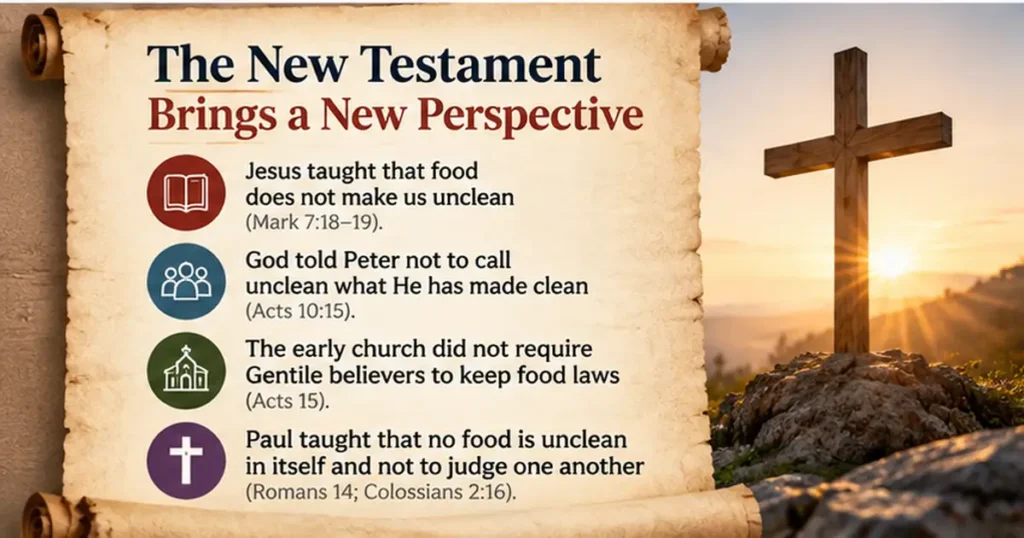
Most Christians eat pork because they believe:
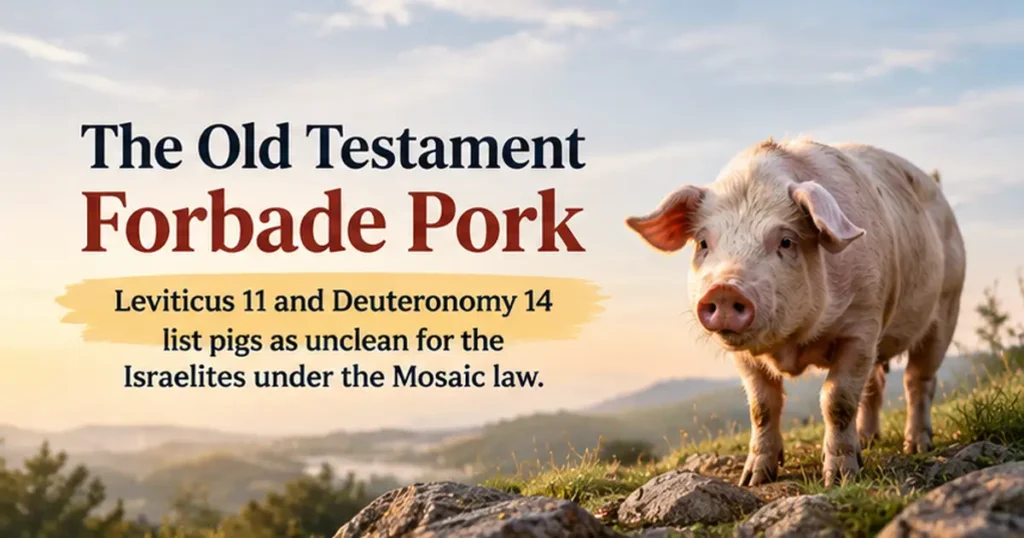
- The prohibition in Leviticus 11 and Deuteronomy 14 was part of the Mosaic covenant given specifically to Israel.
- Jesus taught that food entering the body does not make a person spiritually unclean (Mark 7:18–19).
- God told Peter in a vision not to call unclean what He had made clean (Acts 10:15).
- The early church council in Jerusalem did not require Gentile believers to keep kosher food laws (Acts 15).
- Paul repeatedly taught that no food is unclean in itself and that believers should not judge one another over diet (Romans 14; Colossians 2:16).
A minority of Christian groups, including Seventh-day Adventists and the Ethiopian Orthodox Tewahedo Church, do avoid pork. Their reasons are explained later in this article.
Where in the Bible Does It Say Not to Eat Pork?
The prohibition appears in two main passages in the Law of Moses.
Leviticus 11
Leviticus 11 lists which animals the Israelites could eat. Land animals had to both have split hooves and chew the cud. The pig met only one of those requirements.
“And the swine, though he divide the hoof, and be clovenfooted, yet he cheweth not the cud; he is unclean to you. Of their flesh shall ye not eat, and their carcase shall ye not touch; they are unclean to you.” (Leviticus 11:7–8, KJV)
Deuteronomy 14
Moses repeated the same instruction to a new generation before Israel entered the Promised Land.
“And the swine, because it divideth the hoof, yet cheweth not the cud, it is unclean unto you: ye shall not eat of their flesh, nor touch their dead carcase.” (Deuteronomy 14:8, KJV)
Isaiah’s Warnings
The prophet Isaiah later rebuked Israelites who ate pork as part of their rebellion against God, describing people who sat among graves and “eat swine’s flesh” (Isaiah 65:4, KJV; see also Isaiah 66:17). In context, Isaiah was confronting Israel for breaking their covenant and mixing in pagan practices. These verses are addressed to Israel under the law, not to Gentile believers under the New Covenant.
Why Did God Forbid Pork in the Old Testament?
The Bible does not give a single explicit reason for the pork ban. Scholars and theologians have proposed several explanations, and more than one may be true at the same time.
Holiness and Separation
The most commonly cited purpose is that the food laws set Israel apart from surrounding nations. Leviticus connects the food rules directly to holiness: “ye shall therefore be holy, for I am holy” (Leviticus 11:45, KJV). Eating differently was a daily, visible reminder that Israel belonged to God.
Teaching Spiritual Categories
The categories of clean and unclean helped Israel learn to distinguish between what was set apart for God and what was common. These were lessons in obedience and discernment, not simply menus.
Possible Health Benefits
Some readers point out that undercooked pork could transmit parasites such as trichinella in the ancient world. That may have been a side benefit, but the Bible never presents health as the reason. Many clean animals also carried risks, and some unclean animals did not.
Association With Pagan Worship
Pigs were associated with certain pagan rituals in the ancient Near East. Isaiah’s condemnation of pork-eating alongside grave rituals suggests that, in his time, eating pork could signal participation in idolatry.
What Jesus Taught About Clean and Unclean Food
Jesus addressed food purity directly during a debate with religious leaders about ritual handwashing.
Mark 7: The Heart Matters More Than the Stomach
Jesus explained that what defiles a person comes from inside, from the heart, not from food passing through the body.
“Do ye not perceive, that whatsoever thing from without entereth into the man, it cannot defile him; Because it entereth not into his heart, but into the belly, and goeth out into the draught, purging all meats?” (Mark 7:18–19, KJV)
Many modern translations render the final phrase as Mark’s own comment, explaining that Jesus “declared all foods clean.” Jesus then listed the real sources of defilement: evil thoughts, theft, murder, deceit, pride, and similar sins that come from the heart (Mark 7:21–23).
Did Jesus Eat Pork?
There is no evidence that Jesus ever ate pork. He lived as an observant Jewish man under the law. His teaching in Mark 7 anticipated the change that would become clear after His death and resurrection, when the New Covenant was established.
Peter’s Vision: “What God Hath Cleansed”
The clearest New Testament story about unclean animals is Peter’s vision in Acts 10.
The Sheet From Heaven
While praying on a rooftop in Joppa, Peter saw a large sheet lowered from heaven, filled with all kinds of animals, including those the law called unclean. A voice told him to kill and eat. Peter refused, saying he had never eaten anything common or unclean.
“And the voice spake unto him again the second time, What God hath cleansed, that call not thou common.” (Acts 10:15, KJV)
The vision repeated three times.
Is the Vision About Food or People?
Peter himself later explained that the main point was about people: God was showing him not to call any person unclean, opening the door for Gentiles like the Roman officer Cornelius to receive the gospel (Acts 10:28). Some readers argue the vision is therefore only about people, not food.
Most interpreters, however, see both meanings working together. The vision’s imagery is food, and God’s statement about cleansing animals is the basis for the lesson about people. If God had not truly cleansed those animals, the illustration would not hold. Together with Mark 7 and Paul’s letters, the vision supports the conclusion that food laws no longer separate believers.
The Apostles’ Teaching on Food
After Peter’s vision, the early church had to decide what Gentile converts needed to observe.
The Jerusalem Council
In Acts 15, church leaders met to settle whether Gentile believers had to be circumcised and keep the law of Moses. Their answer was no. They asked Gentiles to avoid a short list of practices that would especially offend Jewish believers or connect them with pagan worship.
“That ye abstain from meats offered to idols, and from blood, and from things strangled, and from fornication.” (Acts 15:29, KJV)
Pork does not appear on that list. If eating pork were still required to be avoided, this would have been the obvious place to say so.
Paul’s Letter to the Romans
Paul addressed disagreements about food between Jewish and Gentile believers in Rome.
“I know, and am persuaded by the Lord Jesus, that there is nothing unclean of itself: but to him that esteemeth any thing to be unclean, to him it is unclean.” (Romans 14:14, KJV)
He added that “the kingdom of God is not meat and drink; but righteousness, and peace, and joy in the Holy Ghost” (Romans 14:17, KJV).
Colossians and First Timothy
Paul told the Colossians not to let anyone judge them over food or drink, describing such rules as “a shadow of things to come” fulfilled in Christ (Colossians 2:16–17). To Timothy, he warned against teachers who commanded people to abstain from foods God created to be received with thanksgiving.
“For every creature of God is good, and nothing to be refused, if it be received with thanksgiving.” (1 Timothy 4:4, KJV)
Galatians: Freedom in Christ
In Galatians 2:11–14, Paul confronted Peter for withdrawing from table fellowship with Gentile believers out of fear of criticism. Paul saw this as a gospel issue: requiring Gentiles to live like Jews in order to be fully accepted contradicted salvation by grace through faith.
Is Eating Pork a Sin for Christians?
For the vast majority of Christians, eating pork is not a sin. The New Testament presents food as morally neutral, something to be received with gratitude.
When Eating Could Become a Problem
Paul did identify situations where eating, even permitted food, could become wrong:
- Violating your own conscience: If you sincerely believe eating pork is wrong, Paul says you should not do it, because acting against conscience is sin for you (Romans 14:23).
- Causing someone else to stumble: Paul said he would rather give up meat entirely than cause a fellow believer to fall (1 Corinthians 8:13).
- Gluttony or lack of self-control: The problem in that case is the excess, not the specific food.
The Principle of Love
Paul summarized his approach this way: “whether therefore ye eat, or drink, or whatsoever ye do, do all to the glory of God” (1 Corinthians 10:31, KJV). Christian freedom is real, but it is meant to be exercised with love.
Common Objections and How Christians Respond
People who believe Christians should still avoid pork often raise a few thoughtful objections. Here is how mainstream Christian teachers typically respond.
“Jesus Said He Did Not Come to Abolish the Law”
In Matthew 5:17, Jesus said He came not to destroy the law but to fulfill it. Most interpreters understand “fulfill” to mean that Jesus completed the law’s purpose. The moral heart of the law, such as love for God and neighbor, continues. Ceremonial elements like sacrifices, purity rituals, and food laws pointed forward to Christ and are fulfilled in Him. Hebrews 8–10 develops this idea at length.
“God Does Not Change”
Malachi 3:6 says the Lord does not change, and that is true of His character. But God’s character has always included making different covenants with different expectations. Before Moses, God allowed Noah to eat “every moving thing that liveth” (Genesis 9:3). The covenant at Sinai added restrictions for Israel. The New Covenant in Christ changed the relationship again. God’s holiness and love stay the same while His instructions for each covenant may differ.
“Isaiah Describes Pork-Eaters Being Judged in the Future”
Isaiah 66:17 speaks of judgment on those who eat swine’s flesh. Most commentators read this in the context of Israelites participating in pagan worship rituals, which Isaiah repeatedly condemned. They do not see it as overriding the explicit New Testament teaching on food.
“Peter’s Vision Was Only About People”
As discussed above, Peter’s own explanation emphasized people (Acts 10:28). Yet Mark 7:19 and Romans 14:14 address food directly, so the case for Christian freedom regarding pork does not rest on Acts 10 alone.
Christians Who Choose Not to Eat Pork
Not all Christians eat pork, and their reasons vary.
Seventh-day Adventists
The Seventh-day Adventist Church teaches that the clean and unclean distinctions in Leviticus reflect health principles that remain valuable. Many Adventists follow those guidelines, and a significant number are vegetarian. They generally present this as a matter of health and stewardship rather than a requirement for salvation.
The Ethiopian Orthodox Tewahedo Church
This ancient church, one of the oldest Christian communities in the world, has long maintained dietary practices similar to Old Testament food laws, including avoiding pork, as part of its distinctive tradition.
Messianic Jews and Hebrew Roots Believers
Many Jewish believers in Jesus continue to keep kosher as an expression of their Jewish identity and heritage. Some Gentile Christians in Hebrew Roots movements also choose to follow Torah food laws. Mainstream churches generally view this as a personal choice rather than a binding command.
Personal Health or Preference
Some Christians simply avoid pork for health, allergy, ethical, or taste reasons. These choices are entirely consistent with Christian freedom.
Pigs and Pork in Bible Stories
Pork appears in several memorable biblical scenes, and each one reflects the Jewish view of pigs as unclean.
The Prodigal Son
In Jesus’ parable, a young man wastes his inheritance and ends up feeding pigs for a Gentile farmer, so hungry that he longs to eat the pigs’ food (Luke 15:15–16). For Jewish listeners, this detail showed just how far he had fallen.
The Gadarene Swine
When Jesus cast demons out of a man in Gentile territory, the spirits entered a large herd of pigs that rushed into the sea (Mark 5:11–13). The presence of a herd that size reminds readers that Jesus was outside Jewish land.
The Maccabean Martyrs
The books of Maccabees, found in Catholic and Orthodox Bibles, tell of Jews who chose death rather than eat pork when a foreign ruler tried to force them to abandon their law (2 Maccabees 6–7). For faithful Jews of that era, refusing pork became a symbol of loyalty to God under persecution.
What About Shellfish, Blood, and Other Foods?
Pork was only one item on the Old Testament list of forbidden foods. The same New Testament reasoning applies to the others.
Shellfish and Other Seafood
Leviticus 11:9–12 permitted only water creatures with both fins and scales, which ruled out shrimp, crab, lobster, and clams. Most Christians eat seafood freely for the same reasons they eat pork.
Blood
The prohibition on consuming blood is older than the law of Moses, given to Noah in Genesis 9:4, and it was repeated in the Jerusalem Council’s letter (Acts 15:29). Christian traditions differ on whether this still applies. Most treat it as a temporary instruction for unity between Jewish and Gentile believers, while some groups, including Jehovah’s Witnesses, continue to observe it strictly.
Food Offered to Idols
Paul addressed meat sacrificed in pagan temples at length (1 Corinthians 8–10). His guidance was the same as for pork: the food itself is not spiritually harmful, but love for others should shape what we eat and when.
What Different Christian Denominations Teach
Here is a broad overview of how major traditions approach pork.
| Tradition | General position on pork |
| Roman Catholic | Permitted; abstain from meat on Ash Wednesday, Good Friday, and Lenten Fridays |
| Eastern Orthodox | Permitted outside fasting seasons; meat avoided during major fasts |
| Baptist and evangelical churches | Permitted; food viewed as a matter of Christian freedom |
| Lutheran, Methodist, Presbyterian, Anglican | Permitted |
| Pentecostal and charismatic churches | Generally permitted |
| Seventh-day Adventist | Generally avoided, based on health teachings and Levitical categories |
| Ethiopian Orthodox Tewahedo | Avoided as part of long-standing tradition |
| Messianic Jewish congregations | Often avoided as an expression of Jewish identity |
Individual congregations and believers may hold views that differ from their denomination’s general practice.
Health Considerations About Eating Pork
Questions about pork often mix theology with health concerns.
Is Pork Safe Today?
In the United States, trichinosis from commercial pork has become rare thanks to changes in farming and inspection practices. The USDA recommends cooking whole cuts of pork to an internal temperature of 145°F followed by a three-minute rest, and ground pork to 160°F.
Nutrition and Moderation
Like other meats, pork varies widely in nutrition. Lean cuts such as tenderloin can fit a balanced diet, while processed products like bacon and sausage are high in sodium and saturated fat. Health organizations generally recommend limiting processed meats. These are dietary questions, not spiritual ones, and they apply equally to other foods.
How to Respond Respectfully to Other Faiths
Pork questions often come up in conversations with Jewish and Muslim friends and coworkers.
Understanding Jewish and Muslim Practice
Observant Jews follow kosher laws rooted in the same Torah passages discussed above. Muslims avoid pork because the Qur’an prohibits it. For both communities, avoiding pork is a meaningful expression of faith and identity.
Practicing Hospitality
Christian freedom to eat pork never requires serving it to someone who abstains. If you host a Jewish, Muslim, or Adventist guest, offering a pork-free meal is a simple act of respect that reflects Paul’s teaching about love.
Answering Questions Graciously
When someone asks why Christians eat pork, you can explain the New Covenant teaching without suggesting that their practice is foolish. A calm explanation of Mark 7, Acts 10, and Romans 14 is usually more persuasive than an argument.
Frequently Asked Questions
Are Christians allowed to eat pork?
Yes, according to the teaching of nearly every Christian denomination. The pork prohibition belonged to the Mosaic law given to Israel. Jesus taught that food does not defile a person, and the apostles taught that Gentile believers are not bound by Old Testament food laws.
Does the Bible say not to eat pork?
Yes, in the Old Testament. Leviticus 11:7–8 and Deuteronomy 14:8 forbade the Israelites from eating pork or touching a pig’s carcass. The New Testament later teaches that these food regulations do not bind followers of Jesus.
Is it a sin to eat pork?
For most Christians, no. Paul wrote that nothing is unclean in itself (Romans 14:14). However, it would be wrong to eat pork if you personally believe it is sinful, or if doing so would deliberately cause a fellow believer to stumble.
Why do some Christians not eat pork?
Some groups, such as Seventh-day Adventists and the Ethiopian Orthodox Tewahedo Church, avoid pork based on their interpretation of Scripture, health principles, or long-standing tradition. Others abstain for personal health or preference.
Did Jesus eat pork?
There is no evidence He did. Jesus lived as an observant Jew under the law of Moses. His teaching in Mark 7 about food not defiling a person, however, laid the groundwork for the New Testament view that all foods are clean.
What does Acts 10 mean for eating pork?
In Acts 10, God told Peter not to call unclean what God had cleansed. The vision mainly taught Peter to accept Gentiles, but its imagery of unclean animals also supports the broader New Testament teaching that food laws no longer separate believers.
Can Christians eat pork during Lent?
Catholics and some other Christians abstain from meat, including pork, on Ash Wednesday and the Fridays of Lent. This is a practice of self-discipline tied to the season, not a claim that pork itself is unclean.
Is ham on Easter appropriate for Christians?
Yes. Many Christian families serve ham for Easter dinner, and nothing in the New Testament forbids it. Easter celebrates the resurrection, and feasting is a long-standing way of marking the joy of the day.
Final Thoughts
The question of whether Christians may eat pork turns out to be a doorway into a much larger story about how God’s covenant with Israel prepared the way for Jesus. The food laws were real, meaningful, and holy for their time. Through Jesus, the New Testament teaches, they gave way to a freedom that values the heart over the plate. Use that freedom with gratitude and kindness. If this explanation helped you, save it for future reference or share it with someone who has asked you this question.






One Comment