
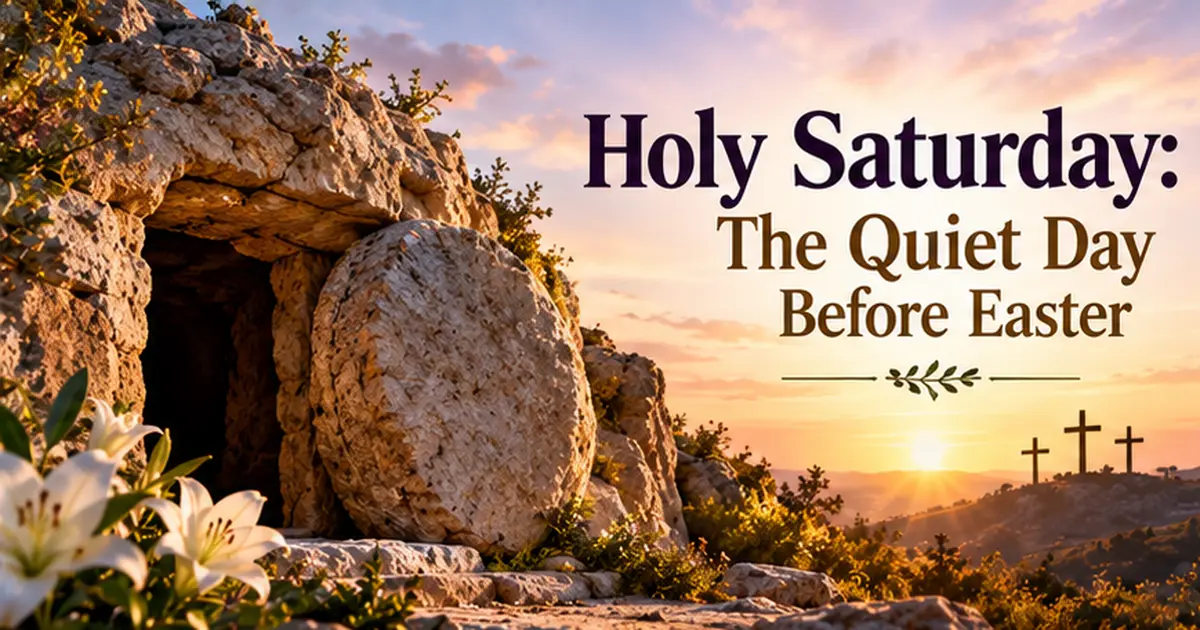
Holy Saturday: 100+ The Quiet Day Between the Cross and the Empty Tomb
Holy Saturday is the day between Good Friday and Easter Sunday, when Christians remember that the body of Jesus lay in the tomb. It is the last day of Holy Week and of Lent, and it is the quietest day on the Christian calendar. Nothing is recorded as happening in the Gospels except a burial, a sealed stone, and a group of people waiting.
That silence is what makes the day worth understanding. Most believers know the story of Friday and the story of Sunday. Saturday is the gap in between, and many people skip over it without ever being told what it means.
This guide explains what Holy Saturday is, when it falls in 2026, 2027, and 2028, what the Bible says about it, and why some churches call it the Great Sabbath. You will also read about the Easter Vigil, traditions around the world, the Christian teaching sometimes called the Harrowing of Hell, and practical ways to spend the day at home. At the end are two short prayers for the waiting.
What Is Holy Saturday?
Holy Saturday is the Saturday before Easter. It follows Good Friday, the day of the crucifixion, and comes before Easter Sunday, the day Christians celebrate the resurrection. Timeanddate.com describes it as the day Jesus lay in the tomb according to the Christian Bible.
You may hear other names for it:
- Easter Eve, because it is the day before Easter.
- The Vigil of Easter, because many churches hold their main service on Saturday night.
- The Great Sabbath, a name used in several traditions, which the next sections explain.
It is a day of reflection, not of celebration. Many Christians treat it as a pause, a deep breath held between grief and joy.
Holy Saturday Dates for 2026, 2027, and 2028
Holy Saturday always falls the day before Easter, so its date changes with Easter. Timeanddate.com lists the following for Western churches.
| Year | Holy Saturday | Easter Sunday |
| 2026 | April 4 | April 5 |
| 2027 | March 27 | March 28 |
| 2028 | April 15 | April 16 |
If you are reading this after April 4, 2026, the next Holy Saturday is March 27, 2027. Eastern Orthodox churches use a different calendar, so their Holy Saturday often comes later. In 2026, for example, Orthodox Easter fell on April 12.
Timeanddate.com also notes that some dates in its table may be preliminary, so it is worth confirming with your own church closer to the day.
What the Bible Says About Holy Saturday
The Gospels say very little about Saturday itself, and that is part of the point. Here is what they do record.
On Friday evening, Joseph of Arimathea asked Pilate for the body of Jesus, wrapped it in linen, and laid it in a new tomb cut from rock, then rolled a large stone across the entrance (Matthew 27:57–60; Mark 15:42–47; John 19:38–42). Nicodemus helped by bringing spices for the burial.
Luke adds a short line about the women who had followed Jesus. They saw where he was laid, prepared spices and ointments, and then “rested the sabbath day according to the commandment” (Luke 23:54–56). Because the Sabbath had begun at sundown on Friday, they could not finish their work until the first day of the week.
Matthew gives the only other Saturday scene. The chief priests and Pharisees went to Pilate, reminded him that Jesus had said he would rise after three days, and asked him to secure the tomb. Pilate gave them a guard, and they sealed the stone (Matthew 27:62–66).
So the Gospel record for Saturday is brief: a closed tomb, a guard at the door, and followers who rested because the law told them to, even in grief. Writers often point out that the silence of the text mirrors the silence of the day.
Why Is It Called the Great Sabbath?
Jewish days begin at sundown. The burial happened late on Friday, and Saturday was the weekly Sabbath, the day of rest commanded in the Ten Commandments. Some Christian traditions call Holy Saturday the Great Sabbath for that reason.
Caleb Orella, writing in a Holy Week reflection series, draws a deeper connection. He notes that God rested on the seventh day after creation (Genesis 2:2), and that Christ’s death on the sixth day parallels the creation of humanity on the sixth day. In this reading, Saturday is a Sabbath rest after a finished work. John 19:30, “It is finished,” sits behind that idea. Orella also points to Hebrews 4, which speaks of a Sabbath rest that remains for God’s people.
You do not need to accept every part of that reading to see the beauty of it. The Great Sabbath is a day when the work of redemption is understood as completed, and the world waits to see it revealed.
What Happened to Jesus on Holy Saturday?
The question “what did Jesus do on Holy Saturday?” appears often. The answer depends on which tradition you ask, and it is honest to say Christians have held several views.
The Body in the Tomb
All Christians agree on the basic fact: his body lay in the tomb. The Apostles’ Creed says he “was crucified, dead, and buried.”
The Descent to the Dead
Many traditions teach that Jesus also descended to the place of the dead and proclaimed victory. The Apostles’ Creed has the line “he descended to the dead,” and some English versions say “into hell.” This teaching is often called the Harrowing of Hell.
Two passages are commonly cited. First Peter 3:18–19 says Christ was “put to death in the flesh, but quickened by the Spirit: by which also he went and preached unto the spirits in prison.” Ephesians 4:9 says he “descended first into the lower parts of the earth.”
Alex Tang notes that this belief is depicted in Eastern Orthodox icons, which show Christ pulling Adam and Eve out of the grave. Interpretations of these verses differ among scholars and denominations, so it is fair to say the Bible does not spell out the details.
Silence and Waiting for the Disciples
On the human side, the disciples did not know what Sunday would bring. They were frightened, grieving, and in hiding. Even though Jesus had told them he would rise, they did not expect it on that Saturday. The day shows what faith looks like without a visible answer.
How Different Churches Observe Holy Saturday
Practices vary widely.
- Roman Catholic. Holy Saturday is a day of quiet prayer and fasting, with no Mass during the day. After nightfall, the church celebrates the Easter Vigil, which begins in darkness and moves toward light.
- Eastern Orthodox. The day is marked with fasting and services that move toward the midnight celebration of Pascha.
- Protestant. Many congregations hold a reflective service or leave the day open, then gather on Sunday morning. Some hold an Easter Eve prayer service or a quiet Scripture reading.
Alex Tang’s overview describes these as differences of emphasis, not of belief. All of them mark the same shift from the burial to the resurrection.
The Easter Vigil
The Easter Vigil is the main service of Holy Saturday for many Christians. It is held after sunset and is often described as the most important service of the church year.
Timeanddate.com explains a few of its symbols:
- A new fire and an Easter candle. Vigil candles represent the light Jesus brings into darkness. The service often begins in a dark church, with one flame spreading from person to person.
- Blessed water. It symbolizes purification and baptism.
- Readings from Scripture. Many churches read a series of passages that tell the story of salvation, from creation to the empty tomb.
- Baptisms. Some churches baptize new believers during the Vigil.
For families who cannot attend a vigil, timeanddate.com says some light an Easter candle at home. That is a simple practice anyone can adopt.
Holy Saturday Traditions Around the World
The day has gathered a handful of customs that vary by culture.
- Decorating Easter eggs. Many American families dye and decorate eggs on Saturday so they are ready for Sunday baskets.
- Blessing of the Easter baskets. The Church at Litchfield Park mentions this tradition, which is associated with Eastern European communities. Families bring food for Easter breakfast to be blessed.
- Blessing of the Animals. In Los Angeles, many people of Mexican descent take part in a tradition that began around 1930. Timeanddate.com notes that the date was moved from January 17 because of cold weather.
- Quiet preparation. Some families clean the house, set the table for Sunday, or prepare food in advance.
Each of these turns waiting into something to do with your hands.
Is Holy Saturday a Public Holiday?
No. In the United States, Holy Saturday is not a federal public holiday. Timeanddate.com says it is a working day and most businesses keep regular hours. Stores are often busy with Easter shoppers.
Ways to Observe Holy Saturday at Home
If your church does not hold a Saturday service, you can still make the day meaningful. These ideas come from both the research and common practice.
- Read the burial accounts. John 19:38–42 and Luke 23:50–56 are short and can be read in a few minutes.
- Create a quiet space. The Church at Litchfield Park suggests a candle, a cross, or a small altar in the corner of a room.
- Keep a gentler pace. Skip entertainment for part of the day and let the quiet do its work.
- Fast from something small. A skipped meal or a day without social media can create room to think.
- Journal about a time of waiting. Write about a season when you could not see the next step, and what you learned from it.
- Contact someone who is struggling. Holy Saturday reminds us of people sitting in their own waiting. A call or a note can mean a great deal.
- Prepare for Sunday. Lay out clothes, set out the Easter meal, or cut flowers for the table.
For children, a simple activity helps: keep a plain wooden cross or small stone on the table, and tell them the story is not over yet.
What Holy Saturday Teaches About Waiting
Holy Saturday does not offer a quick answer. It asks believers to sit inside a hard truth: sometimes the promise has been given, but the evidence has not yet arrived.
AnsweredFaith describes the day as a picture of seasons when God seems silent but is still at work. Psalm 30:5 expresses the same hope in a single line: “Weeping may endure for a night, but joy cometh in the morning.” Hebrews 11:1 defines faith as “the substance of things hoped for, the evidence of things not seen.”
A few lessons many Christians take from the day:
- Waiting is part of faith, not a failure of it.
- Silence is not the same as absence.
- Grief and hope can exist side by side.
- God’s timing is not always visible from where we stand.
- The tomb was not the end of the story.
If you are in a season that feels like Saturday, between a loss and what comes next, this day has something to offer you.
Two Short Prayers for Holy Saturday
A prayer for a quiet day:
Lord, today the world is still. I am not sure what to say, so I will sit with you and let the silence be enough. Hold what I cannot understand. Remind me that you were in the tomb and are still at work in the dark. Teach me to wait without losing hope. Amen.
A prayer for people who are grieving:
God of comfort, I bring you the names of those I miss. Be near everyone who feels today like the longest day of the year. Give us patience for what has not yet happened and trust for what you have already done. Let us rest in your promise until morning comes. Amen.
Frequently Asked Questions About Holy Saturday
What is Holy Saturday?
It is the day between Good Friday and Easter Sunday, when Christians remember Jesus lying in the tomb. It is also called Easter Eve.
When is Holy Saturday in 2026?
Holy Saturday 2026 was April 4. The next date is March 27, 2027, followed by April 15, 2028.
Why is it called Holy Saturday?
It is called Holy because it is part of Holy Week and sits between the crucifixion and the resurrection. Many traditions also call it the Great Sabbath, because it falls on the Jewish Sabbath.
What do Christians do on Holy Saturday?
Many attend an Easter Vigil in the evening. Others pray quietly, fast, read the burial accounts, or prepare for Easter Sunday.
Is Holy Saturday the same as Easter Saturday?
No. Holy Saturday is the day before Easter. “Easter Saturday” can refer to the Saturday after Easter, which is a different day on the calendar.
What is the Harrowing of Hell?
It is the traditional teaching that Jesus descended to the place of the dead after his death and proclaimed victory. Christians base it on passages such as 1 Peter 3:18–20 and Ephesians 4:9, and views on its details vary.
Is Holy Saturday a public holiday in the U.S.?
No. It is a regular working day, and most businesses operate normally.
Conclusion
Holy Saturday is easy to overlook, but it holds one of the deepest lessons of Holy Week: faith can keep going when the answer has not arrived. Whether you attend a vigil, light a candle, or simply slow down, the day offers rest between sorrow and joy. Mark March 27, 2027, on your calendar if you want to plan ahead, and share this with a friend who is in a long season of waiting. Sunday is close, even when Saturday feels endless.






One Comment